Council Of Management Science & Technology

Certificate in Basic Fundamentals of Accounting

- Description
- Curriculum
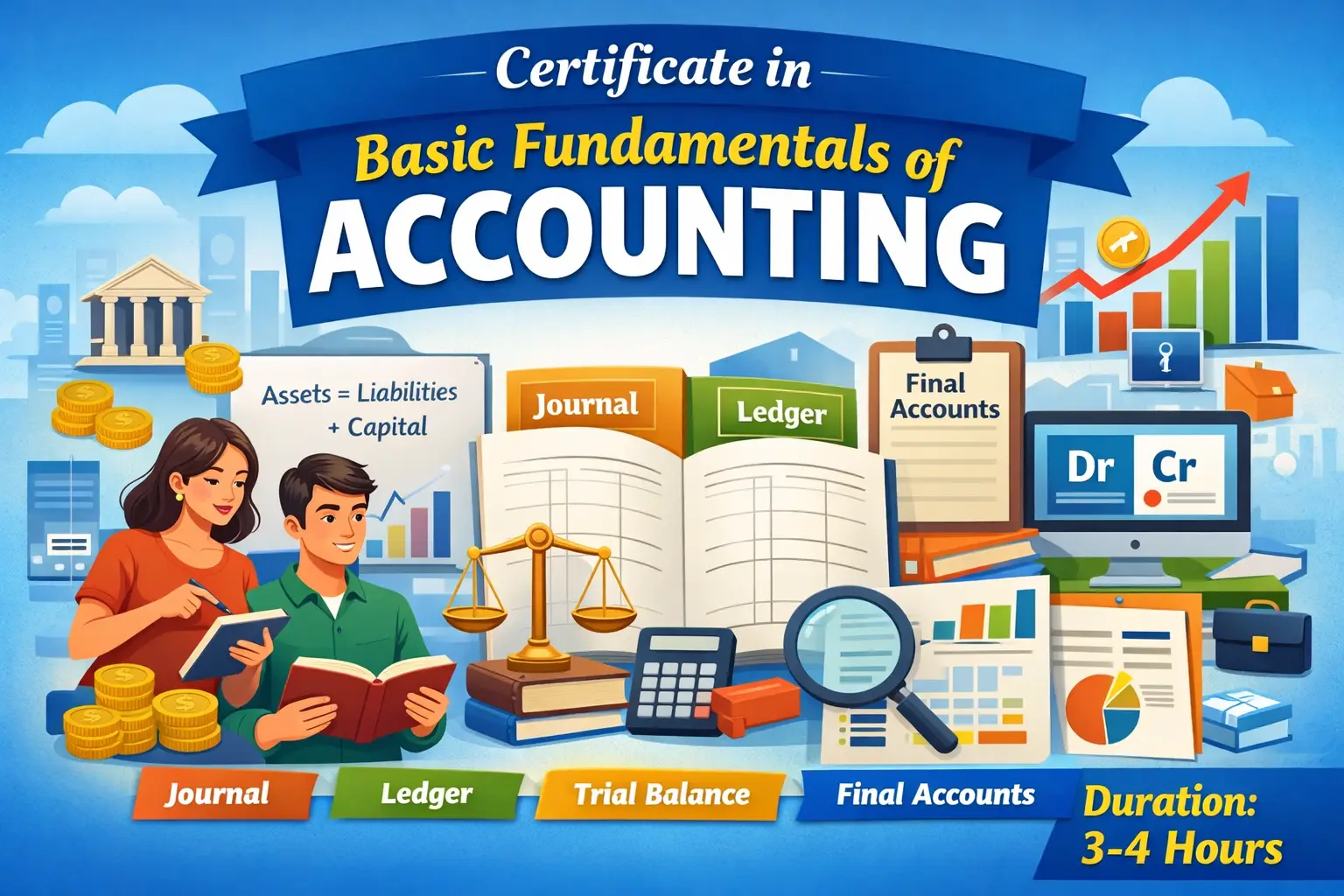
Certificate in Basic Fundamentals of Accounting (1-Day Free Online Mini-Program)
By Council of Management Science & Technology, India (CMSTINDIA)
Mode: Online | Level: Beginner | Duration: 3 Hour | Certification: Yes (Free Digital Certificate)
🔹 Course Overview
The Certificate in Basic Fundamentals of Accounting is a beginner-level foundation program designed to introduce learners to the core concepts of accounting. This course provides a clear and practical understanding of how financial information is recorded, classified, and summarized in a business.
Participants will learn essential accounting terms, the purpose and importance of accounting, and the basic structure of the accounting system. The program covers fundamental topics such as types of accounts, golden rules of accounting, accounting equation, journal entries, ledger posting, trial balance, and an overview of final accounts.
This short-term certification course focuses on building a strong base in accounting, making it ideal for students, beginners, non-commerce learners, and individuals who want to understand business finance or start a career in accounts and office administration.
By the end of the course, learners will be able to understand basic accounting language, analyze simple business transactions, pass elementary journal entries, and interpret basic financial statements.
🔹 Why This Course?
-
100% Beginner friendly
-
No prior experience required
-
Short, skill-focused modules
-
Industry-oriented content
-
Free digital certificate from CMSTINDIA
-
Perfect starting point for accountancy careers
🔹Who Can Join
This course is open to anyone who wants to learn the basics of accounting. No prior commerce or accounting background is required.
✔ School students (10th / 12th pass or appearing)
✔ College students (any stream)
✔ Non-commerce & arts students
✔ Beginners in accounting
✔ Office assistants & clerical staff
✔ Small business owners & shopkeepers
✔ Entrepreneurs & startups
✔ Banking & finance aspirants (foundation level)
✔ Homemakers looking to build professional skills
✔ Anyone interested in understanding business and finance
Eligibility: Open to all | No age limit | No prior accounting knowledge required
🔹 Course Duration & Format
-
Total Duration: 1 Hour
-
Format: Online learning (video / notes / quiz)
-
Assessment: Online MCQ test
-
Certificate: Issued after successful completion
🔹 Course Curriculum
✔ Module 1: Introduction to Accounting
✔ Module 2: Basic Accounting Terminology
✔ Module 3: Types of Accounts & Golden Rules
✔ Module 4: Accounting Equation
✔ Module 5: Journal Entries
✔ Module 6: Ledger & Trial Balance
✔ Module 7: Final Accounts Overview
✔ Module 5: Journal Entries
🔹 Learning Outcomes
After this 1-hour course, the learner will be able to:
✅ Understand accounting basics
✅ Identify different types of accounts
✅ Apply golden rules
✅ Pass simple journal entries
✅ Understand business financial structure
🔹 Certification
Participants will receive a “Certificate in Basic Fundamentals of Accounting” issued by the Council of Management Science & Technology, India (CMSTINDIA) in digital format.
🔹Future Pathways
After completing this course, learners can:
• Pursue advanced courses in Accounting, Commerce, and Finance
• Enroll in Tally, GST, Income Tax, or Computerized Accounting programs
• Continue with Diploma or Degree programs in Commerce and Management
• Prepare for entry-level accounting and office administration roles
• Apply for positions such as Accounts Assistant, Billing Executive, Junior Accountant, Office Assistant, or Cashier
• Support small businesses and startups in maintaining basic financial records
• Build a foundation for professional courses like CA, CMA, CS (foundation level)
• Improve financial understanding for entrepreneurship and self-employment
🔹 Enroll Now
🚀 Start your journey in Accountancy — in just one hour.
🌐 Register at: www.cmstindia.com
-
1
 Meaning of accounting
Accounting is the process of recording, classifying, and summarizing financial transactions of a business in a systematic manner to determine profit or loss and to know the financial position of the business.
-
2
Objectives of accounting
The main objective of accounting is to systematically record financial transactions and provide useful financial information about a business. Accounting helps to determine profit or loss, show the financial position, track income and expenses, support decision-making, and maintain proper financial control. It also provides reliable information to owners, management, banks, and government authorities.
-
3
Importance of accounting
Accounting is important because it keeps systematic financial records, shows profit or loss, reveals the financial position of a business, and helps in planning and decision-making. It supports cost control, prevents financial confusion, ensures legal compliance, and provides reliable information to owners, management, banks, and government authorities.
-
4
Users of accounting information
Users of accounting information are the people or organizations who use financial statements and records to make decisions. These include owners, management, employees, banks, investors, creditors, and government authorities. They rely on accounting information to understand business performance, financial position, profitability, and stability.
-
5
Capital and drawings
💼 Capital – Short Description
Capital is the amount of money, goods, or assets invested by the owner into the business to start or run it. It represents the owner’s claim on the business and is shown as a liability for the business.
💸 Drawings – Short Description
Drawings refer to the money or goods withdrawn by the owner from the business for personal use. Drawings reduce the capital of the business.
-
6
Assets and liabilities
🏦 Assets – Short Description
Assets are the resources and properties owned by a business that have monetary value and help in earning income. Examples include cash, buildings, machinery, furniture, stock, and debtors.
📑 Liabilities – Short Description
Liabilities are the obligations or amounts payable by a business to others. They represent business debts. Examples include loans, creditors, outstanding expenses, and bills payable.
-
7
Income and expenses
💰 Income – Short Description
Income is the money earned by a business from its normal activities such as sales of goods or services, commission, interest received, or rent received. It increases the profit of the business.
💸 Expenses – Short Description
Expenses are the costs incurred by a business to run its operations and earn income, such as rent, salaries, electricity, wages, and transportation. Expenses reduce the profit of the business.
-
8
Profit and loss
📈 Profit – Short Description
Profit is the excess of income over expenses. It means the business has earned more than it has spent.
Profit = Income – Expenses
📉 Loss – Short Description
Loss occurs when expenses are more than income. It means the business has spent more than it has earned.
Loss = Expenses – Income -
9
Debtors and creditors
👤 Debtors – Short Description
Debtors are the persons or customers who owe money to the business for goods sold or services provided on credit. They are also called accounts receivable.
🏪 Creditors – Short Description
Creditors are the persons or suppliers to whom the business owes money for goods purchased or services taken on credit. They are also called accounts payable.
-
10
Goods, purchases and sales
📦 Goods – Short Description
Goods refer to the items purchased or produced by a business for the purpose of resale or manufacturing. They are the main products in which a trading business deals.
🛒 Purchases – Short Description
Purchases mean the buying of goods by a business for resale or production. Purchases can be made in cash or on credit.
🛍 Sales – Short Description
Sales refer to the selling of goods or services by a business to customers in exchange for cash or credit. Sales are the main source of business income.
-
11
Types of accounts
In accounting, all business transactions are classified into three main types of accounts: Personal Accounts, Real Accounts, and Nominal Accounts. This classification helps in applying the golden rules of accounting and recording transactions correctly.
-
12
Personal, real and nominal accounts
👤 Personal Accounts – Short Description
Personal accounts relate to persons or organizations with whom the business deals, such as customers, suppliers, banks, and companies.
🏦 Real Accounts – Short Description
Real accounts relate to assets and properties owned by the business, such as cash, machinery, furniture, land, and buildings.
📊 Nominal Accounts – Short Description
Nominal accounts relate to expenses, losses, incomes, and gains, such as salary, rent, interest, commission, and discount.
-
13
Meaning of debit and credit
➕ Debit (Dr.) – Short Description
Debit means to record an amount on the left side of an account. It generally shows an increase in assets and expenses or a decrease in liabilities, capital, and income.
➖ Credit (Cr.) – Short Description
Credit means to record an amount on the right side of an account. It generally shows an increase in liabilities, capital, and income or a decrease in assets and expenses.
-
14
Golden rules of accounting
The golden rules of accounting are basic principles used to decide which account to debit and which to credit in every business transaction. They are based on the three types of accounts: Personal, Real, and Nominal, and help in recording transactions correctly under the double-entry system.
-
15
Concept of accounting equation
The accounting equation shows the basic relationship between assets, liabilities, and capital. It states that Assets = Capital + Liabilities. This means whatever a business owns (assets) is financed either by the owner (capital) or by outsiders (liabilities). This equation is the foundation of the double-entry system and must always remain balanced.
-
16
Assets = Capital + Liabilities
The equation Assets = Capital + Liabilities explains that everything a business owns (assets) is financed either by the owner’s investment (capital) or by amounts owed to outsiders (liabilities). This equation is the foundation of accounting and always remains balanced for every business transaction.
-
17
Effect of transactions on accounting equation
Every business transaction affects the accounting equation Assets = Capital + Liabilities. A transaction may increase or decrease assets, capital, or liabilities, but it will always keep the equation balanced. This shows the double effect of each transaction and forms the basis of the double-entry system.
-
18
Simple illustrations
Simple illustrations are basic examples used to explain accounting concepts easily. They show how business transactions affect assets, capital, and liabilities and help learners clearly understand the accounting equation and double-entry effect.
-
19
Meaning of journal
A journal is the book of original entry in which all business transactions are recorded first in chronological order. It shows the date, accounts affected, debit and credit amounts, and a brief description of each transaction.
-
20
Journal entry format
The journal entry format is the standard structure used to record business transactions in the journal. It includes the date, accounts to be debited and credited, amounts, and narration. This format helps in recording transactions clearly, systematically, and correctly under the double-entry system.
-
21
Identification of accounts
Identification of accounts means recognizing which accounts are affected in a business transaction and classifying them as personal, real, or nominal. This step is essential to decide the correct debit and credit while recording journal entries.
-
22
Passing basic journal entries
Passing basic journal entries means recording simple business transactions in the journal by identifying the accounts involved and applying the golden rules to debit and credit them correctly. It helps in systematically documenting financial activities under the double-entry system.
-
23
Meaning of ledge
A ledger is the main book of accounts in which all business transactions are classified and recorded account-wise. It receives entries from the journal and shows the detailed record of each account, helping to find balances and prepare the trial balance and final accounts.
-
24
Posting from journal to ledger
Posting means transferring journal entries into the respective ledger accounts. Each debit and credit recorded in the journal is posted to the debit and credit side of the concerned ledger accounts to classify transactions account-wise.
-
25
Balancing of ledger accounts
Balancing of ledger accounts means finding the difference between the total debit side and total credit side of an account to know its closing balance. This balance is carried forward to the next period and used for preparing the trial balance and final accounts.
-
26
Trial balance and its purpose
A trial balance is a statement prepared by listing all ledger account balances to check the arithmetical accuracy of accounting records. Its main purpose is to verify that total debits equal total credits and to provide a base for preparing final accounts.
-
27
Trading account – basic concept
A trading account is prepared to find out the gross profit or gross loss of a business for a particular period. It shows the direct income and direct expenses related to buying and selling of goods, such as purchases, sales, opening stock, and closing stock.
-
28
Profit & loss account – basic concept
A Profit & Loss Account is prepared to find out the net profit or net loss of a business for a particular period. It records indirect incomes and indirect expenses and shows the overall financial performance of the business after calculating gross profit or gross loss.
-
29
Balance sheet – basic concept
A balance sheet is a financial statement that shows the financial position of a business on a particular date. It lists the assets on one side and liabilities and capital on the other side, showing what the business owns and what it owes.
-
30
Importance of final accounts
Final accounts are important because they show the profit or loss and the financial position of a business. They help owners, management, banks, and government authorities to analyze performance, make decisions, ensure legal compliance, and plan future growth.
-
31
 MCQs + True/FalseThis quiz is designed to assess the learner’s understanding of basic accounting concepts covered in the course, including accounting fundamentals, types of accounts, golden rules, journal entries, ledger, trial balance, and final accounts. It helps evaluate knowledge, accuracy, and practical awareness at a foundation level.
 Google